The science of tumor-educated platelets.

Why the RNA inside your platelets can reveal cancer early, and the peer-reviewed evidence behind TEPScan.

Last updated

Platelets carry a tumour’s fingerprint.

Tumours change the RNA inside the platelets circulating in your blood.Source: Best et al., Cancer Cell (2015): RNA-seq of tumor-educated platelets TEPScan reads that change.

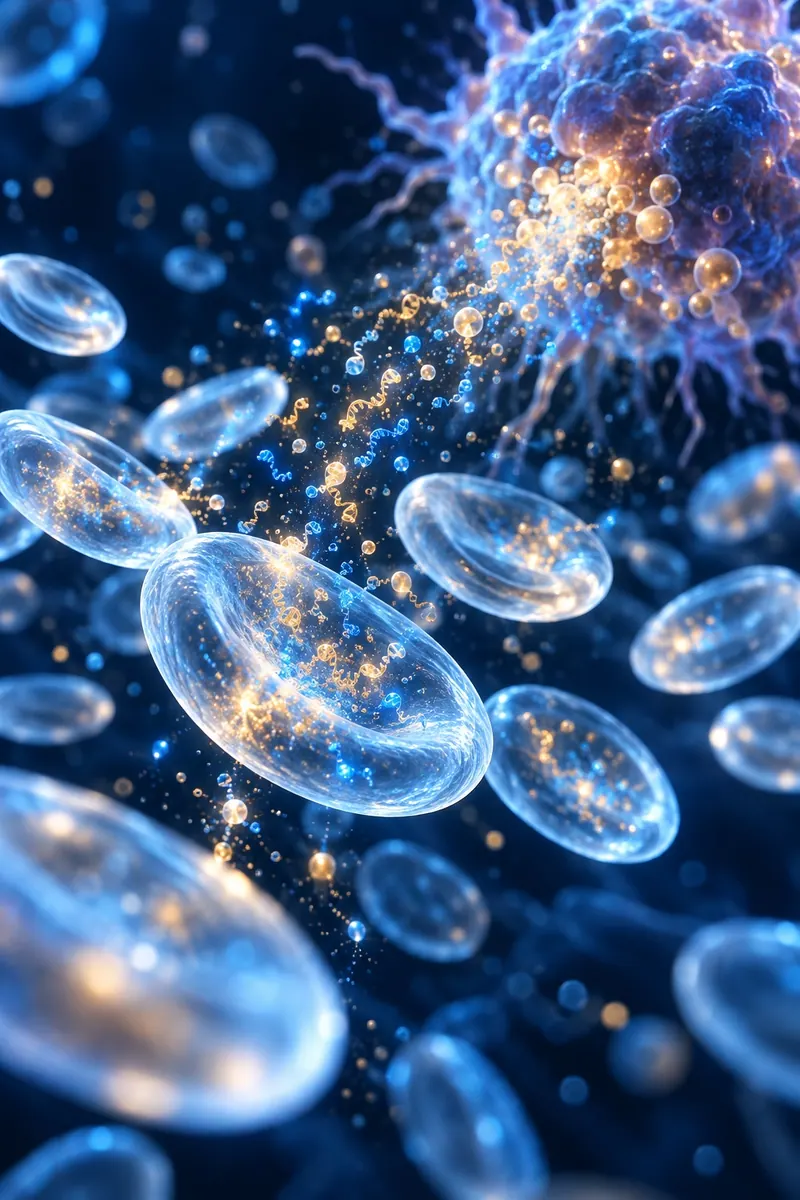
3D illustration of a tumour cell releasing RNA that circulating platelets take up

Illustration

Tumour cell releasing RNA
  1. Cancer sheds its signal.

    Cancer cells release RNA and signalling molecules into the bloodstream, even when the tumour is small.

  2. Platelets get educated.

    Circulating platelets take up tumour RNA and change their own RNA profile. These are tumor-educated platelets, or TEPs.

  3. TEPScan reads the signal.

    qRT-PCR measures the 11-gene TEP panel (patent application filed), and a batch-agnostic AI ensemble turns it into a result.

What are tumor-educated platelets?

Tumor-educated platelets (TEPs) are blood platelets whose RNA content has been altered by contact with a tumour. Platelets are the second most abundant cell in blood. As they circulate, they take up RNA and other molecules released by cancer cells, and the tumour also influences how platelets are made and spliced. The result is an RNA profile that differs measurably between people with and without cancer.Source: Best et al., Cancer Cell (2015): RNA-seq of tumor-educated platelets

Because platelets live for only 7–10 days, their RNA is a fresh, near real-time snapshot of what is happening in the body. And because they are plentiful, there is far more signal to work with than in circulating tumour DNA, which is scarce in early-stage disease.Source: Tumor educated platelets: a novel biosource for cancer detection (review)

From 1,000 genes to 11

Early TEP research used RNA sequencing of thousands of genes, which is accurate but too expensive and slow for population screening. In 2020, researchers at IIIT-Delhi, including Care Onco’s Dr. Gaurav Ahuja and TEPScan inventor Prof. Debarka Sengupta, published a signature of just 11 platelet genes in BMC Genomics. It enables accurate blood-based diagnosis of non-small cell lung cancer, with an AUC of 0.91–0.94, comparable to a much larger gene panel.Source: Goswami et al., BMC Genomics 21:744 (2020)

Eleven genes can be measured with qRT-PCR, a fast and low-cost technique available in almost every diagnostic lab. That is what makes an affordable, scalable test possible.
Validated in India and Norway.

400

samples in training and evaluation

From cancer centres in India and Norway.

~91%

average accuracy (AUC)

Including Stage I disease.

150

breast cancer validations

Including a Norway study with Stavanger University Hospital.

Peer-reviewed publication

Goswami et al. “Molecular signature comprising 11 platelet-genes enables accurate blood-based diagnosis of NSCLC.” BMC Genomics 21:744 (2020).

Patent filing

Indian patent application TEMP/E-1/46638/2020-DEL: a gene panel for detecting blood-based genetic markers of non-small cell lung cancer.

Validation partners

  • AIIMS New Delhi
  • Rajiv Gandhi Cancer Institute & Research Centre (RGCIRC)
  • IIIT-Delhi
  • Stavanger University Hospital, Norway
  • AIG Hospitals · upcoming

What the evidence does and doesn’t show yet

The published 11-gene signature was developed and tested for non-small cell lung cancer. The authors note that its performance should not be considered conclusive for other cancer types. Care Onco is extending validation to more than ten cancer types through multi-centre studies in India and Norway. Results for each module will be shared as they mature.

TEPScan is currently for Research Use Only. Regulatory work with India’s CDSCO has started. See the FAQ for availability, or contact the team about research collaborations.

Collaborate on the evidence.

We work with cancer centres and researchers to extend TEPScan validation.